
Solar energy
How many solar panels do I need in Florida? Sizing from your real kWh
How to size a solar system from your kWh, how much a kW produces in Florida, why 400 W panels are the standard, and why designing at 110% of usage makes sense.
Written by Yorgan Rojo · Energy advisor, My Home SolutionsUpdated 8 min read
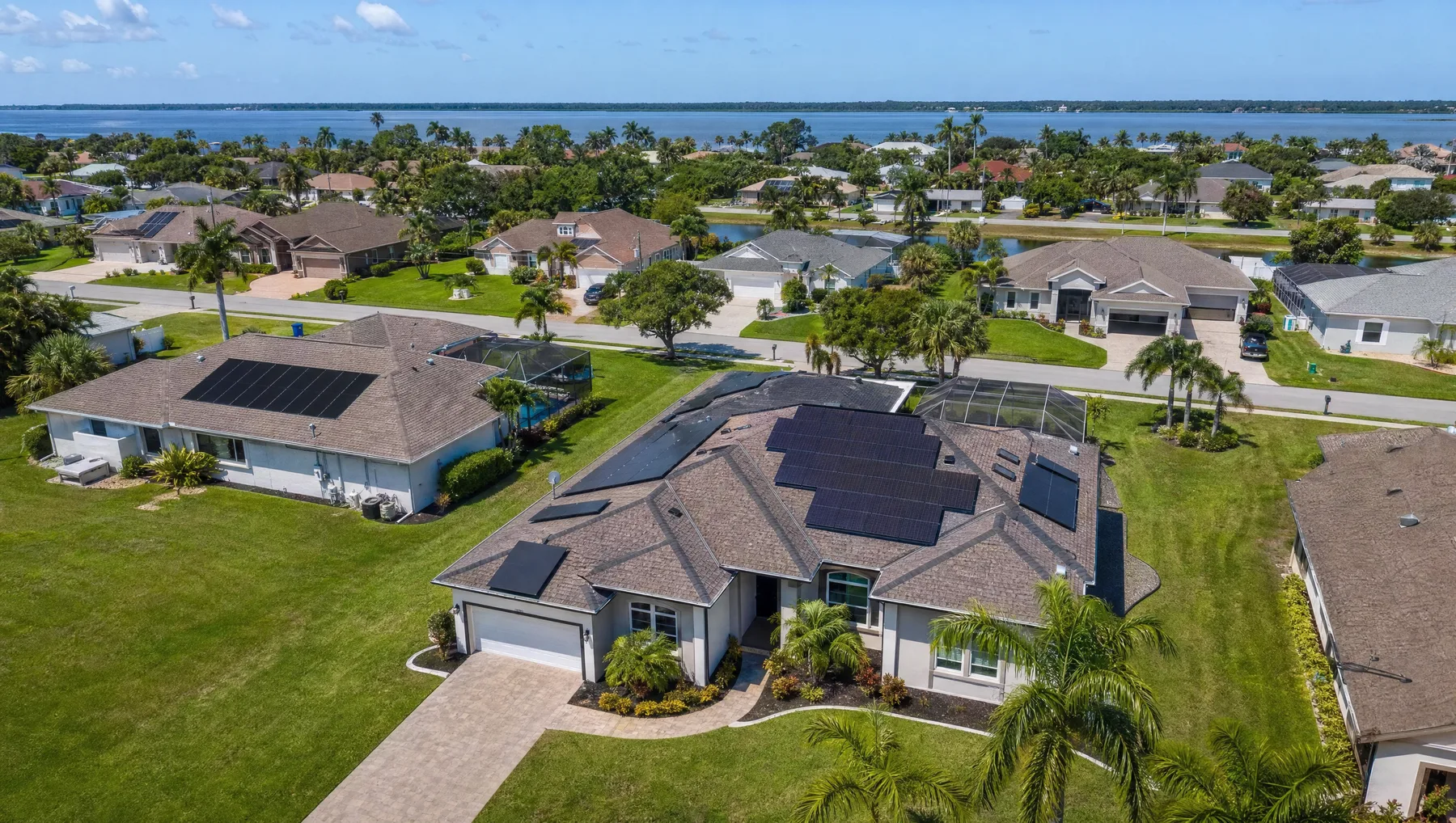
The average Florida home uses 1,104 kWh per month according to the EIA, about 13,250 kWh a year. At the state’s typical yield (around 1,450 kWh per installed kW per year), covering that usage at 110% takes a system of about 10 kW: roughly 25 panels at 400 W. Your real number comes from your 12 bills, not from this average.
Where does system size come from?
From three inputs: your annual usage in kWh, how much a kW produces in your area, and what percentage of usage you want to cover. The formula EnergySage uses is the standard one:
Size (kW) = annual usage (kWh) ÷ yield per kW (kWh/kW/year) × coverage percentage
Then: number of panels = size in W ÷ panel wattage in W.
Everything else (how many bedrooms, how many people, “homes like yours”) is an approximation that can miss by a lot. A kWh is the energy unit on your bill and the only figure that reflects how you actually live.
How much does 1 kW of panels produce in Florida?
Between 1,390 and 1,530 kWh per year, based on PVWatts simulations (NREL’s tool, the national renewable energy laboratory) comparing Pensacola with Fort Myers. The spread comes from latitude, afternoon clouds and roof orientation. Florida averages about 5.5 peak sun hours a day according to SolarReviews; EnergySage describes the same thing as a “production ratio” of 1.1 to 1.6 across the U.S., with Florida at the upper end.
For the math in this guide we use 1,450 kWh/kW/year as a midpoint. Your installer should run PVWatts (or equivalent software) with your exact address, tilt and orientation, and show you the result month by month.
Table: monthly usage, system size and panel count
Assumptions: 1,450 kWh/kW/year, 400 W panels, design at 110% of usage.
| Monthly usage | Annual usage | System at 100% | System at 110% | 400 W panels |
|---|---|---|---|---|
| 800 kWh | 9,600 kWh | 6.6 kW | 7.3 kW | 18-19 |
| 1,100 kWh (FL average) | 13,200 kWh | 9.1 kW | 10.0 kW | 25 |
| 1,500 kWh | 18,000 kWh | 12.4 kW | 13.7 kW | 34 |
| 2,000 kWh | 24,000 kWh | 16.6 kW | 18.2 kW | 46 |
For reference, EnergySage reports the average quoted system in Florida is 14.53 kW, which suggests many solar homes sit well above the state’s average usage: large families, pools, aging AC units.
Why 400 W panels?
Because that is what the market sells. According to EnergySage, 97% of residential panels in 2026 are 400 W or higher. A 400-440 W panel is about the same size as a 350 W panel from a few years ago; what changed is efficiency. If a proposal offers panels well under 400 W, ask why: it may be old inventory.
Panel wattage matters for space, not production. If your usable roof is small, higher-wattage panels let you reach the needed size with fewer units.
Why design at 110% and not 100%?
Because 100% has no margin. A 100% design covers exactly your historical usage in a normal-weather year. One hotter summer, a month with houseguests, a new electric car, and the system falls short: you pay grid power at full rate.
At 110%, overproduction in good months accumulates as a kWh credit under net metering and covers the bad months. That margin is what separates a serious design from one that falls short in the first hot summer.
Heads up: above 115% it stops paying off. Year-end surplus is settled at the utility’s generation rate, not the full rate you pay. Oversizing beyond that is buying expensive panels to produce cheap credit. And with FPL, going past 10 kW moves you to Tier 2 interconnection: a $400 fee and liability insurance of up to $1 million. A salesperson pushing you to 12 kW “so there’s extra” needs to explain that.
What makes your real number different?
- Orientation and tilt. A south-facing roof produces more than east or west; the gap can be double digits in percent.
- Shade. A tree or the neighbor’s house during midday hours cuts real production and may call for microinverters (see string inverters vs microinverters).
- Planned changes. Electric car, pool, electric water heater, a new room. All of that gets added before sizing, not after.
- Usable roof area. Chimneys, skylights, vents and the fire-code setbacks reduce available space.
- The roof itself. If it has few years left, the right order is roof first. We explain it in your roof before solar.
How is the size set with the subscription?
Same logic, but the sizing risk is not yours. With the solar subscription the system is sized from your last 12 months of usage in that home. That is why at least 12 months of history is a requirement: a new or just-purchased home has no data to size from.
The difference is which number you look at. If you buy, you look at kW, panels and price per watt. With the subscription, you do not pay per panel. Your number is the savings: at least 30% on your total bill, guaranteed in writing. If the system produces less than the annual minimum in writing, you get back the equivalent percentage of the rent. And at the annual true-up, if you paid more than 70% of what you would have paid without the system, you get the difference back.
| What gets decided | If you buy | With the subscription |
|---|---|---|
| Size in kW | You, with the installer | The installation team, from your 12 months of usage |
| Risk of falling short | Yours: you pay grid kWh at full rate | Covered by the production guarantee and the annual true-up |
| Number you compare | Price per watt and production | Savings % in writing and a 3- or 5-year term |
When it does NOT make sense
- When your annual usage is low: a small system spreads fixed installation costs over few kWh, and the cost per kWh produced climbs.
- When usable roof space cannot cover a meaningful share of usage: a system at 40% of usage still saves, but the payback is slower and it has to be decided with numbers.
- When the salesperson sized the system without seeing your bills: that is not a design, it is a generic quote.
- When you just moved in: without 12 months of usage in that home there is no real basis for sizing, and the subscription does not qualify yet either.
What to check before you decide
- Gather your 12 bills and add up the kWh (not the dollars) to get your real annual usage.
- Ask for the month-by-month production simulation for your address and confirm it totals at least 110% of your usage.
- Verify how many panels, at what wattage, and that they fit in the usable roof area with the code-required setbacks.
- Ask which interconnection tier the system falls into with your utility and whether that means a fee or insurance.
- Compare the price per watt for the proposed size against the ranges in our solar cost in Florida guide.
Frequently asked questions
Can I install more panels than I need and sell the electricity?
If my usage goes up later, can I add panels?
Are higher-wattage panels better?
Figures vary by home, usage and bill. Incentives vary by county, income and installation type. Confirm any tax matter with your tax preparer.
Sources
- EIA — Table 5.A: Residential average monthly bill and consumption by state, 2024
- EnergySage — How many solar panels do I need?
- NREL — PVWatts Calculator
- Florida Solar Authority — Solar production estimates across Florida regions (PVWatts)
- SolarReviews — Average peak sun hours by state
- FPL — Net Metering Tiers
- EnergySage — Florida solar panel cost (average system size)
Keep learning
Solar energy
How home solar works: from your roof to your bill
What happens to solar energy from the moment your roof makes it until you use it, what happens at night, and why Florida heat costs you output.
7 min read
Solar energy
How to read a solar proposal: the 7 numbers you have to find
The seven numbers in a solar proposal (monthly production, offset, $/W, escalator, warranties, minimum charge, tax credit): where to find them and what's reasonable.
9 min read
Solar energy
Net metering in Florida in 2026: how your utility credits the energy you don't use
What net metering is, how it works with Duke, FPL and TECO in Central Florida, why a minimum charge always remains, and when the year-end bill comes in your favor.
7 min read
2 minutes · No pressure · Spanish or English
Your Central Florida home could start saving this year.
Tell us about your home in 2 minutes. We review your real bill and tell you how much you would save with the subscription. If it doesn’t make sense for you, we say so.