Solar energy
How home solar works: from your roof to your bill
What happens to solar energy from the moment your roof makes it until you use it, what happens at night, and why Florida heat costs you output.
Written by Yorgan Rojo · Energy advisor, My Home SolutionsUpdated 7 min read
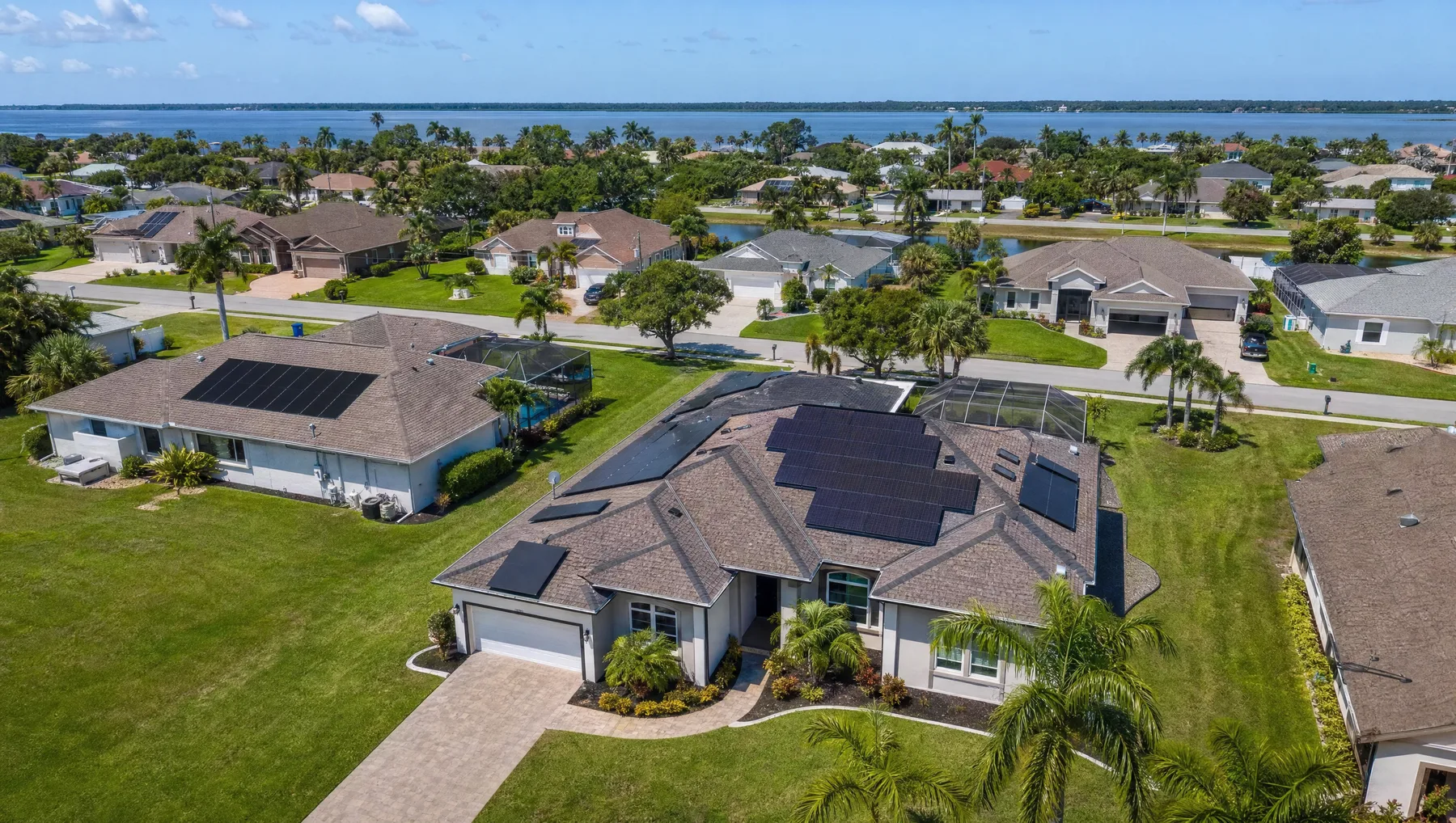
A home solar system does four things in order: the panels turn light into direct current, the inverter turns it into alternating current, your home uses what it needs at that moment, and whatever is left flows out to your utility’s grid as a credit. At night the flow reverses: you draw from the grid and spend that credit. None of this requires you to change how you live.
What does each part of the system do?
Each component has one job, and knowing it protects you from proposals that sell “technology” instead of results.
| Component | What it does | Typical lifespan |
|---|---|---|
| Panels | Turn light into direct current (DC) | 25+ years under a production warranty |
| Inverter | Turns DC into alternating current (AC), what your home uses | 10-15 years for a string inverter; 25 years for microinverters (per warranty) |
| Bidirectional meter | Measures what comes in and what goes out to the grid | Installed by the utility |
| Monitoring | App that shows production in real time | Depends on the inverter manufacturer |
Panels are the most durable part. The inverter is the piece you are most likely to replace during the system’s life; our guide to string inverters vs microinverters explains which one fits your roof.
Where does the electricity the panels make actually go?
It goes to your home first, and only the surplus goes to the grid. The inverter delivers AC power to your main electrical panel, and from there every appliance draws what it needs. If the air conditioner is running at noon, a good share of the production is consumed right there.
When you produce more than you use, the surplus passes through the bidirectional meter to the grid. With FPL, Duke Energy and TECO that surplus is credited 1 to 1 under net metering: every kWh (kilowatt-hour, the unit your usage is measured in) you send out is worth the same as one you buy. FPL applies the surplus to next month’s bill and, at year-end, settles what is left at its average cost of generation. Details are in our net metering in Florida guide and the glossary.
What happens at night?
At night the panels produce zero and your home draws from the grid like always. The difference is that the credit you built up during the day covers that nighttime usage. That is why net metering works as a “virtual battery”: it stores nothing physically, but on paper it balances your day and your night.
This has a practical consequence: you do not need a battery to save with solar. A battery gives you power when the grid goes down, which matters in Florida because of hurricanes, but it is a backup expense, not a savings expense. We cover it in the home solar batteries guide.
What happens during a power outage?
The system shuts off automatically, even in full sun. It is a mandatory safety measure: if your inverter kept pushing electricity into a line the utility believes is dead, it could electrocute a line worker. Only systems with a battery and a transfer switch can isolate the home from the grid and keep running.
If a salesperson tells you “with panels you won’t lose power in a hurricane,” they are leaving out the battery and its cost.
Does Florida heat help or hurt?
It hurts, even if that sounds backwards. Panels run on light, not heat, and heat lowers their output. According to EnergySage, a typical panel loses 0.3% to 0.5% of its power for every degree Celsius above 25 °C (77 °F). A Florida roof in July can push the panel surface well past that, so a “400 W” panel does not deliver 400 W at 2 p.m. in August.
What compensates is the number of sun hours. Florida averages about 5.5 peak sun hours per day according to SolarReviews, with humidity and afternoon clouds keeping it below the Southwest. The net result is good, but only if the design uses real data for your area and not the number on the panel’s label.
Heads up: the number that matters is not panel wattage but estimated annual production in kWh for your address. A proposal that only says “10 kW of panels” without stating how many kWh it will produce month by month tells you nothing useful. Ask for it in writing. Our guide on how to read a solar proposal covers what else to look for.
Why doesn’t my bill go to zero?
Because you always pay to stay connected. FPL charges a $25 monthly minimum base bill according to its rate document, and Duke and TECO have their own fixed charges. No system size eliminates that charge. That is why we never promise a “zero bill”: the realistic goal is for production to cover your energy usage and leave only the fixed charge. With the subscription, the savings of at least 30% are calculated on your total bill, with the minimum charge already included.
If you are served by a municipal or cooperative utility (OUC, JEA, GRU, Lakeland Electric), the credit rules are different and need to be checked before sizing anything.
Does anything change with the energy subscription?
The physics does not change: the roof produces, the inverter converts, your home uses the power and the surplus is credited the same way. What changes is who takes care of each piece. With the solar subscription you do not buy the equipment: the installation team puts it in, maintains it, insures it and repairs it, with a full warranty. Monitoring is included too.
You pay a fixed monthly amount for 3 or 5 years and save at least 30% on your total bill, guaranteed in writing. If the system produces less than the annual minimum in writing, you get back the equivalent percentage of the rent. One important detail: the subscription is solar energy only, with no battery. When the power goes out, the system shuts off like any other system without a battery.
When it does NOT make sense
- If your roof has only a few years of life left: installing on a roof that needs replacing soon forces you to remove and reinstall the panels. Read your roof before solar.
- If your bill is very low: the minimum charge eats a large share of the possible savings and the payback stretches out.
- If the roof is heavily shaded most of the day: real production can land well below the estimate.
- If your utility does not credit 1 to 1: the surplus is worth less and the design changes. For the subscription, only homes on Duke Energy, FPL or TECO qualify.
- If what you want is power during an outage: that takes a battery, and the subscription does not include one.
What to check before you decide
- Ask for estimated monthly production in kWh, not just installed capacity.
- Confirm which inverter type the proposal includes and how many years of warranty it carries.
- Verify with your utility whether your home is on FPL, Duke, TECO or a municipal, because the credit changes.
- Ask whether the system includes a battery, and what happens when the power goes out.
- Bring 12 months of bills to the diagnosis so the size comes from your actual usage.
Frequently asked questions
Do solar panels work when it's cloudy?
If the power goes out, do my panels keep working?
Do I need to rewire my house?
Figures vary by home, usage and bill. Incentives vary by county, income and installation type. Confirm any tax matter with your tax preparer.
Sources
Keep learning
Batteries and backup
Home solar batteries in Florida in 2026: what they do, what they cost, and when you don't need one
How a solar battery works, the difference between kWh and kW, what one costs installed, and why with 1-to-1 net metering in Florida it is for backup, not savings.
7 min read
Solar energy
How many solar panels do I need in Florida? Sizing from your real kWh
How to size a solar system from your kWh, how much a kW produces in Florida, why 400 W panels are the standard, and why designing at 110% of usage makes sense.
8 min read
Solar energy
Net metering in Florida in 2026: how your utility credits the energy you don't use
What net metering is, how it works with Duke, FPL and TECO in Central Florida, why a minimum charge always remains, and when the year-end bill comes in your favor.
7 min read
2 minutes · No pressure · Spanish or English
Your Central Florida home could start saving this year.
Tell us about your home in 2 minutes. We review your real bill and tell you how much you would save with the subscription. If it doesn’t make sense for you, we say so.