
Solar energy
Solar cost in Florida in 2026: the real price per watt
Sourced $/W ranges for Florida, a cost-by-size table, what drives the price up or down, and what a fair proposal looks like next to an inflated one.
Written by Yorgan Rojo · Energy advisor, My Home SolutionsUpdated 8 min read
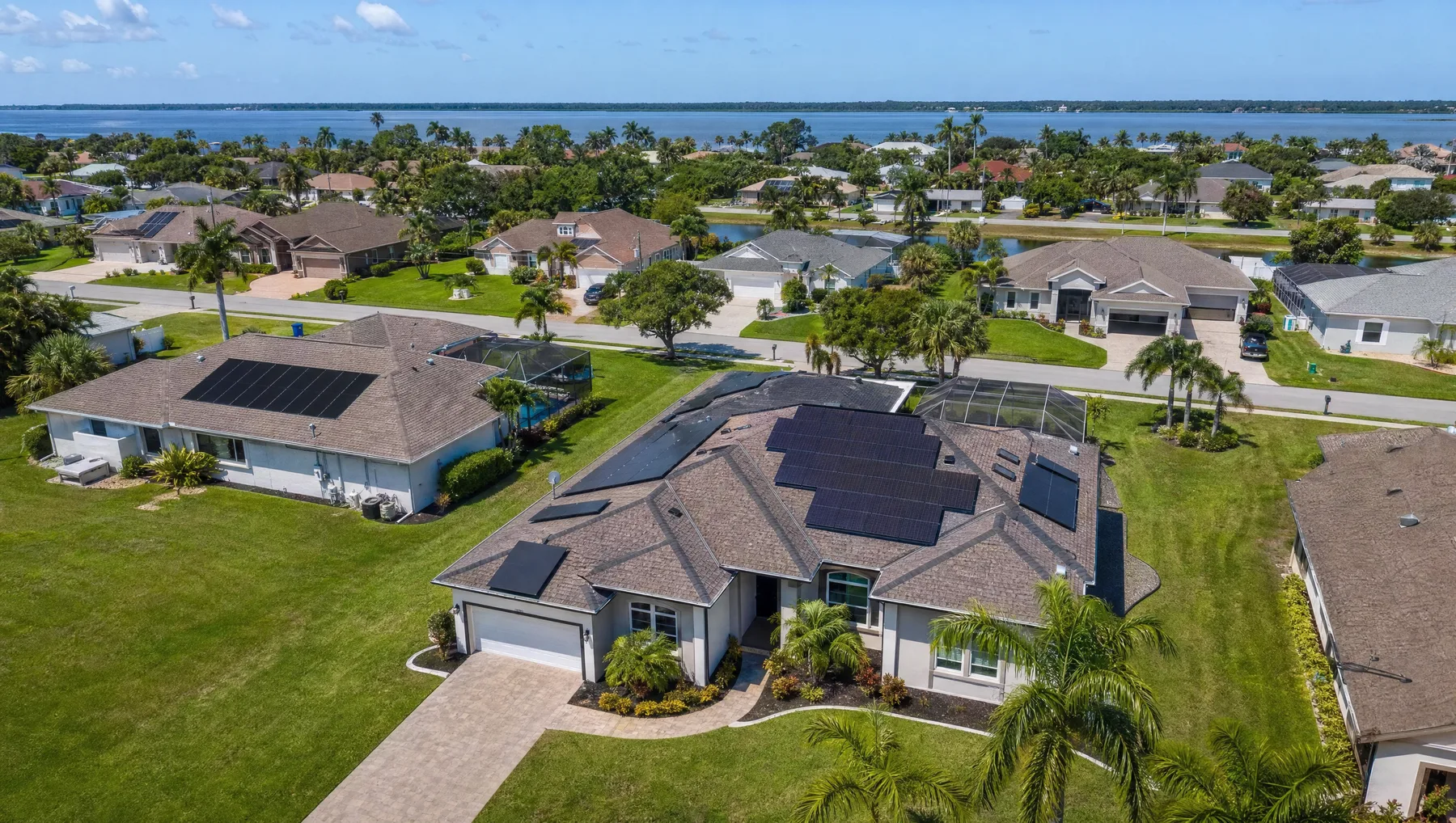
A residential solar system in Florida currently costs between $2.12 and $2.71 per installed watt when paid in cash, according to EnergySage and SolarReviews (both with September 2026 data). A 10 kW system runs about $21,000 per EnergySage; the average system quoted in Florida, 14.53 kW, comes in around $30,833 before incentives. Financed, the price per watt goes up.
How much does it cost by system size?
It depends on the size in kW and on who is quoting. This is EnergySage’s Florida table (cash prices, before incentives, September 2026), with the SolarReviews equivalent for comparison:
| Size | EnergySage ($2.12/W) | SolarReviews (before incentives) |
|---|---|---|
| 5 kW | $10,614 | ~$15,000 ($3.00/W) |
| 6 kW | $12,736 | ~$17,040 ($2.84/W) |
| 7 kW | $14,859 | ~$19,110 ($2.73/W) |
| 8 kW | $16,982 | ~$21,120 ($2.64/W) |
| 10 kW | $21,227 | ~$25,200 ($2.52/W) |
| 14.53 kW (FL average) | $30,833 | — |
A note on SolarReviews: its table publishes prices with the 30% federal credit already deducted; the values above are recalculated to gross by dividing by 0.7, because that credit no longer applies to a buyer (explained below). Its headline figure is $2.71/W for a 7.2 kW system ($19,512).
Price per watt drops as size grows: fixed costs (permit, design, crew, interconnection) get spread over more watts. That is why a 5 kW system costs more per watt than a 10 kW one.
Why don’t EnergySage and SolarReviews agree?
Because they measure different markets. EnergySage reports quotes from its platform, where several installers compete for the same customer and prices tend to fall. SolarReviews averages a broader market that includes door-to-door and financed sales. Both are valid; together they give you the reasonable range. A cash quote inside $2.10-$2.80/W is at market. Above $3.50/W cash, ask for a line-by-line explanation.
What drives the price up or down?
Five things explain almost every difference between proposals.
- Financing. With a loan, the installer usually folds the lender’s fee (dealer fee) into the price. EnergySage notes there is no standard percentage and it varies by lender; SolarReviews reports about $3.25/W financed in Florida versus $2.71/W cash. That markup is not interest: it is a charge inside the principal. Read ways to get solar compared.
- Inverter type. Microinverters or optimizers cost more than a string inverter but perform better with shade and carry longer warranties. See string inverters vs microinverters.
- Roof. Tile, metal or complex pitches raise labor; a shingle roof with one or two planes is the cheapest case.
- Electrical panel. If your main panel is old or lacks capacity, the upgrade gets added. It should appear as a separate line.
- Battery. A battery can add a large share of the total. It is not part of “solar”; it is a separate product with its own decision (see home solar batteries).
Which incentives apply in Florida in 2026?
Fewer than the ads claim. What is still in place:
- Sales tax exemption. Florida exempts solar systems and their components from sales tax (DSIRE). It is already built into any serious price.
- Property tax exemption. The value the system adds does not raise your assessment, under Florida Statute 196.182.
- Federal 25D credit (30% for buyers): ended. The IRS confirms it does not apply to expenditures after December 31, 2025, and the expenditure counts as made when installation is completed. If you buy today, you do not get it.
- Federal 48E credit (third-party-owned systems). Still available to the system owner in a lease, PPA or subscription, with a deadline at the end of 2027 under the code. Whatever benefit exists reaches you as a lower monthly price, not as an IRS check. Details in federal solar tax credit 2026. Confirm any figure with your tax preparer.
Heads up: many proposals and online calculators still show a “price after the 30% credit.” If you buy in 2026, that number is false for you. A salesperson using it is either out of date or inflating the savings on purpose. Either one is a reason to get another quote.
What does a fair proposal look like?
A fair proposal shows the total price, the price per watt, the size in kW DC, the panel and inverter make and model, and estimated month-by-month production. It shows cash and financed prices separately, with the rate, the term and any lender fee spelled out. It includes the electrical panel upgrade if needed, and the battery as an optional line.
An inflated proposal hides the price per watt, blends battery and panels into a single number, shows “25-year savings” built on a rate escalator nobody guarantees, and uses a tax credit that no longer exists. Our guide on how to read a solar proposal has the full checklist.
And what does the subscription cost?
With the subscription there is no price per watt to pay, because you do not buy the system. No upfront cost and no loan. You pay a fixed monthly amount for 3 or 5 years, with no escalator, and save at least 30% on your total bill, guaranteed in writing. That calculation comes from your last 12 months of usage and includes the utility’s minimum charge.
The costs that are yours when you buy are included in the subscription:
| Cost | If you buy | With the subscription |
|---|---|---|
| Installed system | You, cash or loan | Included |
| Permits and interconnection | Inside the price | Included |
| Maintenance and repairs | You, outside warranty | Included |
| Inverter replacement | You, if it fails outside warranty | Included |
| Equipment insurance | You | Included |
| Remove and reinstall for a new roof | You | Once per term at no cost |
Not every home qualifies. You need a single-family home with a shingle roof, at least 12 months of usage in that home, Duke Energy, FPL or TECO, and a location within about 50 miles of Orlando. There is a soft credit check that does not affect your score.
Heads up: the subscription is not for everyone. If your bill is very high, your roof is ideal and you have the cash or strong credit to buy at a market price, buying can save you more over 25 years. We will tell you, with your home’s numbers.
When buying does NOT make sense
- When the financed price per watt clearly exceeds the market range with no technical explanation: you are paying the lender’s fee with your roof.
- When your bill is low: at $2.12/W, a 5 kW system ($10,614 per EnergySage) takes far longer to pay off than a 10 kW system in a high-bill home, and the minimum charge never goes away.
- When the roof needs replacing within a few years: the cost of removing and reinstalling eats into the savings.
- When you need the cash liquid: a well-structured loan or a debt-free subscription can be a better decision than draining savings. We compare them in ways to get solar compared.
- When you do not want to handle maintenance, repairs and the inverter for 25 years: that is exactly what the subscription puts in writing as included.
What to check before you decide
- Divide the total price by the system’s DC watts: if the cash result is well above $2.80/W, ask for written justification.
- Ask for cash and financed prices separately, with the lender fee spelled out.
- Confirm the proposal does not deduct a 30% federal credit that no longer applies to buyers in 2026.
- Verify that the electrical panel upgrade and the battery appear as their own line items.
- Compare at least two proposals of the same kW size; comparing different-size systems by total price tells you nothing.
- Put next to them what you would save with the subscription in your specific home: the diagnosis gives you both numbers from your 12 bills.
Frequently asked questions
Why do two serious sources give different prices?
Is the financed price the same as the cash price?
Can I still take the 30% federal credit if I buy?
Figures vary by home, usage and bill. Incentives vary by county, income and installation type. Confirm any tax matter with your tax preparer.
Sources
- EnergySage — Florida solar panel cost (September 2026)
- SolarReviews — How much do solar panels cost in Florida? (2026)
- IRS — FAQs: energy efficient home improvement and residential clean energy property credits
- 26 U.S. Code § 48E — Clean electricity investment credit
- DSIRE — Florida Solar and CHP Sales Tax Exemption
- Florida Statutes § 196.182 — Exemption of renewable energy source devices
- EnergySage — Solar loans
Keep learning
Incentives and tax credit
Federal solar tax credit in 2026: the 30% ended for buyers, not for third-party systems
What happened to the 30% solar tax credit (25D) after December 31, 2025, why 48E remains in force through 2027 for third-party-owned systems, and what it means for buying versus leasing in Florida.
7 min read
Solar energy
How many solar panels do I need in Florida? Sizing from your real kWh
How to size a solar system from your kWh, how much a kW produces in Florida, why 400 W panels are the standard, and why designing at 110% of usage makes sense.
8 min read
Solar energy
How to read a solar proposal: the 7 numbers you have to find
The seven numbers in a solar proposal (monthly production, offset, $/W, escalator, warranties, minimum charge, tax credit): where to find them and what's reasonable.
9 min read
2 minutes · No pressure · Spanish or English
Your Central Florida home could start saving this year.
Tell us about your home in 2 minutes. We review your real bill and tell you how much you would save with the subscription. If it doesn’t make sense for you, we say so.