
Your electric bill
The utility minimum charge in Florida: why your bill never reaches $0
FPL and Duke bill a $30 minimum base bill every month even if solar covers all your energy; TECO bills a daily basic charge. What it includes, what it does not, and how it affects net metering.
Written by Yorgan Rojo · Energy advisor, My Home SolutionsUpdated 7 min read
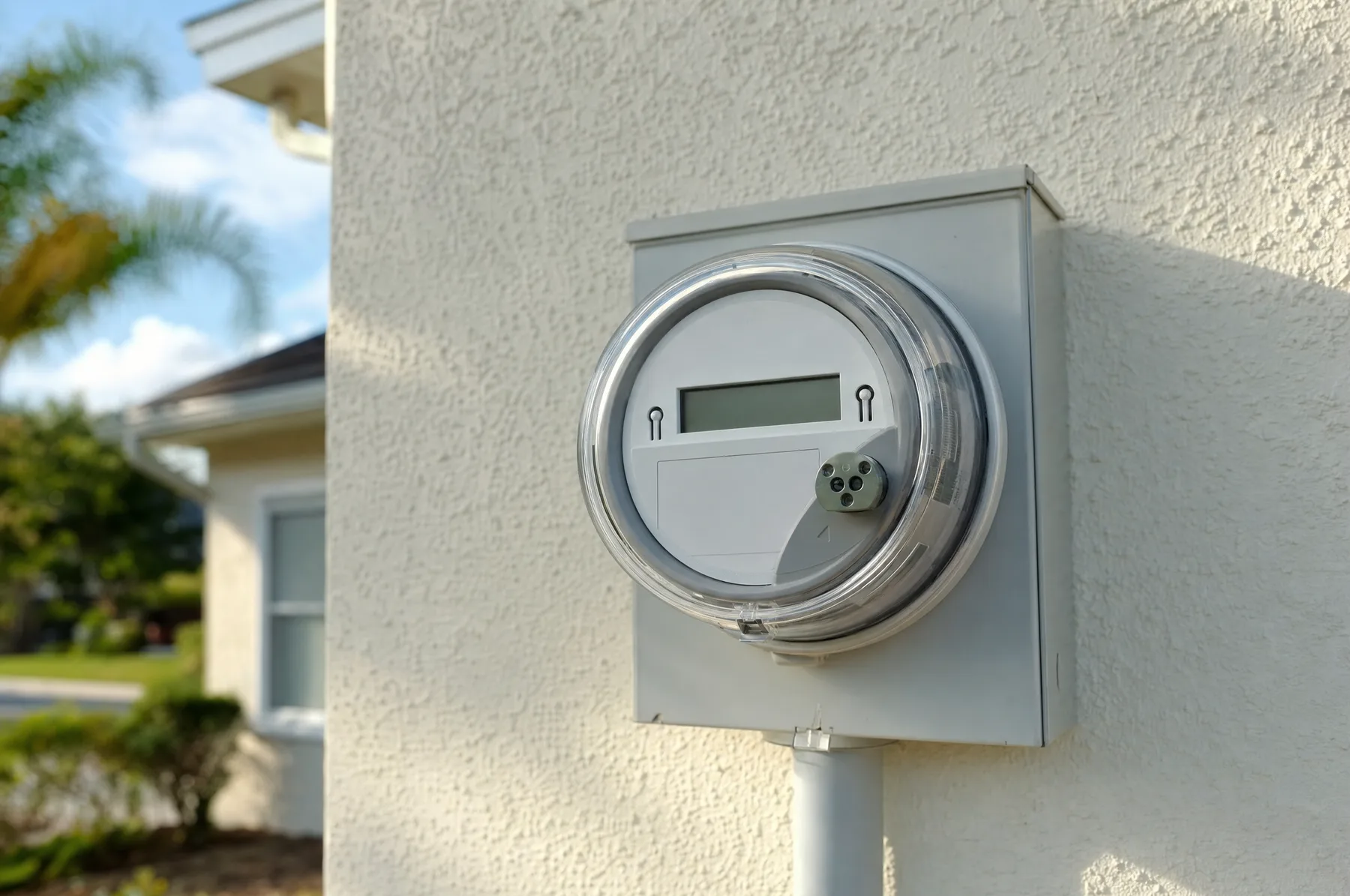
Your electric bill never reaches $0 because the utility charges you for being connected, not just for using power. At FPL and Duke Energy Florida that floor is a $30 minimum base bill that applies even when your roof produces more energy than you use; at TECO it is a basic charge billed per day. With solar energy, the realistic goal is the minimum charge, not zero.
What exactly is the minimum charge?
It is a minimum monthly amount the utility bills every residential account to cover fixed system costs: meter, poles, transformers and wires that are there whether or not you use power. The Public Service Commission (PSC) approves it inside rate agreements. Short definition at /en/glossary/minimum-charge.
It matters because it changes the solar math: net metering credits every kWh you send to the grid 1 to 1 (/en/learn/net-metering-florida), so the energy portion really can hit zero. The minimum is what is left.
How does it work at each utility?
| Utility | Minimum | What it includes | Source |
|---|---|---|---|
| FPL | $30/month minimum base bill | Base charge + base energy. Excludes fuel, clauses and taxes | Sept 2026 rate sheet; net metering FAQ |
| Duke Energy Florida | $30/month minimum bill (since January 2022) | Customer charge ($14.35 in 2026) + usage; if under $30, the difference is added | “Understanding the Minimum Bill” page; June 2026 insert |
| TECO | No separate minimum on the rate sheet | Basic service charge per day (0.45/day in 2026) + taxes | January 2026 rate insert |
FPL: the minimum lives inside the “base bill”
FPL explains that the base bill is the base charge ($10.52 a month in 2026) plus the base energy charge. If that sum falls below $30, a “Minimum base bill charge” line appears with the difference. As you use more, that line shrinks until it disappears. What does not count toward the minimum: fuel, storm protection, conservation, capacity, environmental and taxes. So a solar home that buys zero net kWh pays $30 of base bill plus the storm charge on the kWh it did draw at night, plus taxes.
Duke: the minimum is an adjustment at the end
Duke describes it as “a minimum usage charge of $30 per month”. If you are paying the customer charge and your net usage for the month is zero, Duke adds an adjustment to reach $30. Duke states 95% of accounts never see it, and that a modification exists for income-qualified customers (who are not net metering customers) in 2025, 2026 and 2027.
TECO: no minimum line, but there is a floor
Tampa Electric’s 2026 residential rate sheet shows no separate minimum charge. What it has is a basic service charge billed for every day in the period, plus per-kWh charges on whatever you do draw from the grid, plus taxes. With solar, your floor on TECO is lower than on FPL or Duke, but it is not zero.
What happens to the surplus at year-end?
At FPL, leftover kWh accumulate month to month in your “bank” and, if you still have a surplus when the December meter is read, a credit goes on that bill calculated at FPL’s average annual cost of generation, a value recalculated every year that depends mostly on natural gas prices. That generation cost is lower than the full rate you pay. That is why a system that produces far more than you use is not a good deal: they buy cheap what they sold you dear. The full math, including the cases where the December bill comes in negative, is at /en/learn/how-much-solar-really-saves.
Heads up: the pitch “with solar your bill goes to zero” is false at all three utilities and whoever uses it knows it. The minimum charge arrives either way, solar or not. That is why the My Home Solutions subscription already builds it into the savings math, and the production guarantee is in writing: if the system produces less than the annual minimum, you get back the equivalent percentage of the rent.
How much does the minimum weigh in your decision?
It depends on the size of your bill. At 1,000 kWh a month on FPL (about $136 in August 2026), a $30 minimum leaves plenty of room for solar to make sense. At 400 kWh a month, the minimum and taxes are nearly half of what you pay, and no system removes them. That is why in the diagnosis we look at kWh before dollars (/en/learn/what-is-a-kwh-home-usage).
In the My Home Solutions solar subscription, the savings of at least 30%, guaranteed in writing, are calculated on your total bill, minimum charge included, using your last 12 months of usage. At 12 months there is a yearly review: if you paid more than 70% of what you would have paid without the system, you get the difference back. With any offer, check that the agreement says in writing how it treats the minimum.
When NOT to worry about the minimum
- If you use more than 800 kWh a month: the minimum is a small fraction and does not change the decision.
- If you do not have or plan solar: the minimum is already inside what you pay and you will not notice it.
- If your problem is a summer spike: the lever there is the air conditioner, not the bill’s floor.
When it does matter: bills under $100, second homes with empty months, and any solar proposal showing “$0” as the projected bill.
What to check before deciding
- Look for the minimum line on your bill (FPL: “Minimum base bill charge”; Duke: adjustment to $30). If it shows up, your usage is low and solar yields less.
- Ask that any solar proposal show the projected bill month by month with the minimum, storm charges and taxes.
- Ask how the agreement treats the minimum charge if they promise a savings percentage.
- If you are on Duke and qualify by income, ask about the minimum bill modification.
- Compare your utility: Duke Energy, FPL, TECO. The subscription works only with these three; municipal utilities like OUC or KUA and co-ops do not qualify.
Frequently asked questions
If I produce more than I use, do they pay me back?
Is the minimum charge a penalty for going solar?
Can I avoid the minimum by disconnecting from the grid?
Figures vary by home, usage and bill. Incentives vary by county, income and installation type. Confirm any tax matter with your tax preparer.
Sources
- FPL — Residential Rates and Clauses Effective September 2026 ($30 minimum base bill note)
- FPL — Net Metering FAQs
- FPL — Minimum Base Bill (how it is calculated)
- Duke Energy Florida — Understanding the Minimum Bill
- WFLA — Duke Energy Florida customers to have minimum $30 bills
- Duke Energy Florida — Our residential rates as of June 2026 (bill insert)
- Tampa Electric — Important Rate Information, January 2026
Keep learning
Your electric bill
How to read your Duke Energy Florida bill in 2026
Customer charge, energy charge, fuel, asset securitization, taxes and the $30 minimum: what each line on your Duke Energy bill means and where to see your usage.
7 min read
Your electric bill
How to read your FPL bill in 2026, line by line
What every charge on your FPL bill means (base charge, energy, fuel, storm, taxes), where your 13-month kWh history lives, and how to download the PDF from the app or FPL.com.
8 min read
Solar energy
Net metering in Florida in 2026: how your utility credits the energy you don't use
What net metering is, how it works with Duke, FPL and TECO in Central Florida, why a minimum charge always remains, and when the year-end bill comes in your favor.
7 min read
2 minutes · No pressure · Spanish or English
Your Central Florida home could start saving this year.
Tell us about your home in 2 minutes. We review your real bill and tell you how much you would save with the subscription. If it doesn’t make sense for you, we say so.