
Solar energy
How much solar energy really saves in Florida (and why some do not)
Why solar energy does not leave you with a $0 bill, what the minimum charge is, how much is left when there is a monthly payment, and the five reasons some people save nothing.
Written by Yorgan Rojo · Energy advisor, My Home SolutionsUpdated 8 min read
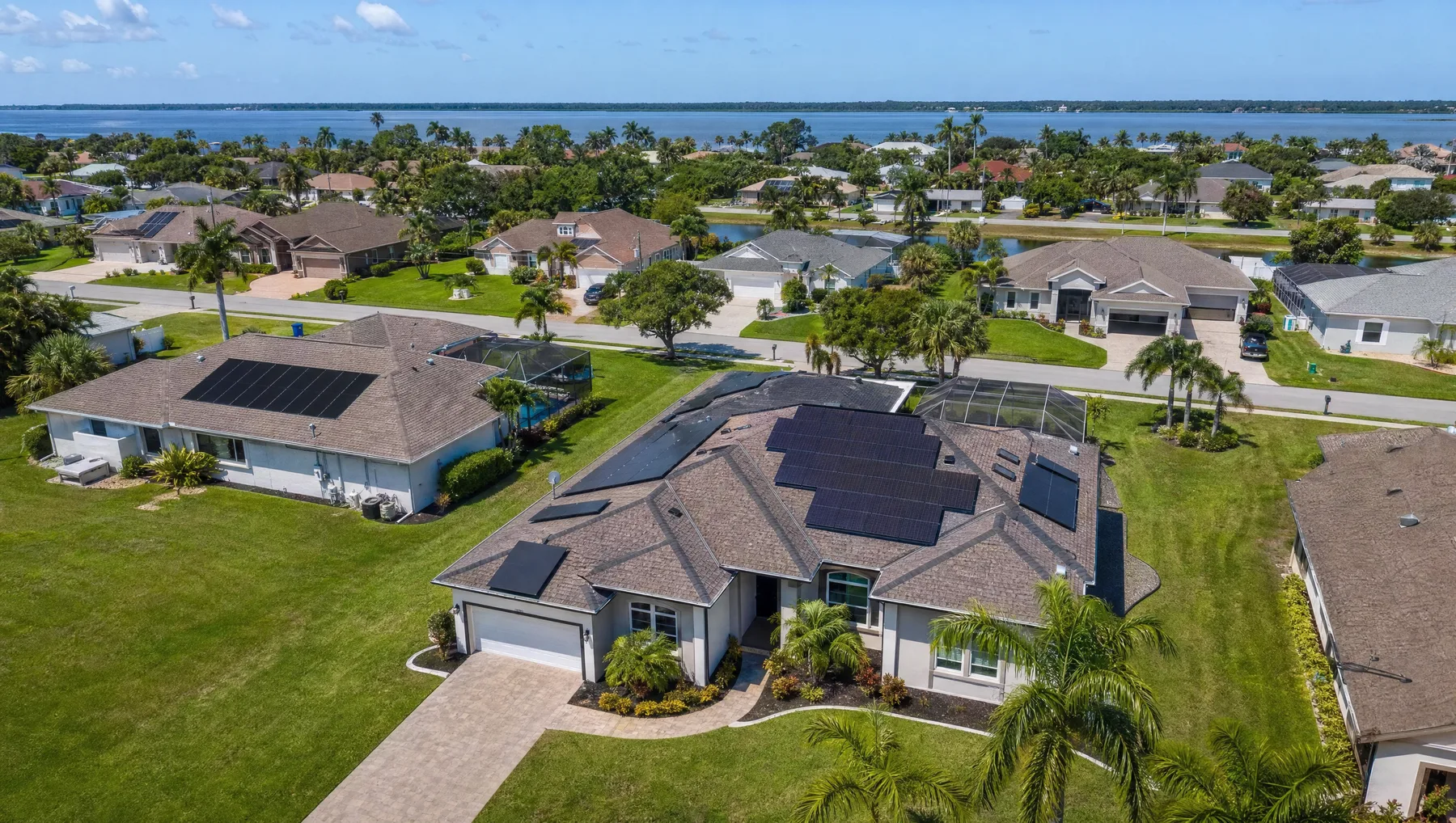
Solar energy in Florida does not leave you with a $0 bill. It attacks the energy part, but your utility’s minimum charge always remains. And if there is a monthly payment for the system, your real savings are the gap between what you used to pay and what you pay now. People who “saved nothing” almost always had an undersized system, an escalator, shade, more usage or an installer that disappeared.
Which part of the bill can solar energy attack?
Only the energy part, not the fixed charges. Your bill has two blocks: what you pay for the kWh you use and what you pay to stay connected. The sun’s energy reduces the first. The second does not move.
With Florida numbers: the average residential rate is 15.38 cents per kWh, per EIA data reported by EnergySage (April 2026). Average usage is 1,104 kWh a month, per the EIA. That works out to about $170 a month in energy. That is the target. FPL’s minimum charge is $30 a month per its rate document. Duke and TECO have their own; we explain it in the utility minimum charge.
| Line item | Average FL home (before) | With well-designed solar energy |
|---|---|---|
| Energy (1,104 kWh × 15.38 ¢) | ~$170 | ~$0 on an annual average (net metering credit) |
| Minimum / connection charge (FPL) | included | $30 |
| System payment (loan, lease or subscription) | $0 | depends on the agreement |
| Bill + system payment | ~$170 | $30 + system payment |
If you pay cash, your monthly savings are nearly the whole energy line, but you put up the capital. If there is a monthly payment, your savings are the gap between what you used to pay and the new total (minimum charge + payment).
How much is left when there is a monthly payment?
Less than many ads claim. An example with round numbers: a system replaces $170 of energy with a $30 minimum charge plus an $85 to $125 payment. That leaves $15 to $55 a month in savings: 9% to 32% of the original bill. It is an illustrative example, not a quote. With higher bills or lower payments, the percentage goes up.
That is why the My Home Solutions subscription does not give you a range. It gives you a floor: you save at least 30% on your total bill, minimum charge included, guaranteed in writing. At month 12 there is a yearly true-up. If you paid more than 70% of what you would have paid without the system, you get the difference back, with no cap. Details in how the subscription works.
EnergySage estimates a 9.84-year payback (time to recover the investment) for Florida and about $64,627 in 25-year savings for the average system bought in cash. It is a reasonable calculation with published assumptions, but it is an average. Your number depends on your usage, your rate and your roof.
Heads up: the industry sells savings with sky-high percentages or with “eliminate your bill”. Neither is true for a home connected to FPL, Duke or TECO. If the proposal shows a $0 bill, the minimum charge was left out. If it shows a very high percentage, it probably deducted a federal credit that no longer exists for buyers or plugged in an optimistic rate increase.
What is the minimum charge and why can it not be eliminated?
It is what it costs to have the grid available even if you do not use it. FPL explains that its minimum base bill covers fixed costs that do not vary with usage: meter, billing, poles, transformers. It applies to every customer, including net metering customers. The only way to avoid it is to disconnect from the grid. That means large batteries, a generator and a cost that makes no sense for a Florida home.
That is why we will not promise you a $0 bill. What is in writing in the subscription is that the 30% is calculated with that minimum charge inside. How your energy gets credited is in net metering in Florida.
Why do some people say they “saved nothing”?
Because one of these five things happened to them, sometimes several.
- System too small for the usage. One hot summer and the system falls short: you pay grid kWh at full rate on top of the payment. Ask for the month-by-month simulation (how many panels do I need).
- Escalator in the contract. Many leases and PPAs raise the payment every year. Solar.com reports that a 2.9% annual escalator is common. At that pace, the payment nearly doubles over 25 years. If the rate rises less than that, the savings evaporate.
- Shade nobody accounted for. A tree that grew or a neighbor who built. Real production lands below the simulation.
- Usage went up. A new pool, an electric car, an aging AC that got worse, or “I have solar now, I’ll leave the AC at 70”. The system produces the same; the house uses more.
- Installer gone. The inverter failed, nobody fixed it and the system has been at zero for months. The payment keeps coming. Read solar panels not producing: what to do.
All five are catchable before signing. The problem was almost always in the design or the contract. In the subscription, the production guarantee and the yearly true-up put that risk on the installation team, not on you.
When it does NOT make sense
- When your energy charge is low: with little usage, the minimum charge and any payment eat nearly all the possible savings.
- When the proposed payment equals or exceeds your current energy line: you save nothing today, you are only betting the rate goes up.
- When the contract has a high escalator and you plan to stay many years: the early-year savings get handed back in the late years.
- When the roof, shade or the utility (a municipal one with its own rules) keep real production from reaching the target.
- When your bill is very high, your roof is ideal and you have capital: buying can save more over 25 years than a subscription. We tell you if that is your case.
What to check before you decide
- Split your bill into the energy line (kWh × rate) and the fixed charge: only the first can be saved.
- Compare the proposed monthly payment against your total bill today, not against “the bill in 2050”.
- Ask whether the contract has an escalator and how much; request the year-by-year payment table.
- Ask for the month-by-month production simulation and the guaranteed minimum production, in writing.
- Run your case with the solar calculator or ask for your home’s real numbers in the diagnosis.
Frequently asked questions
Can I get to a zero bill with solar energy?
How much do I save if I finance the system?
Do savings grow over time?
How is the 30% guaranteed in the subscription?
Figures vary by home, usage and bill. Incentives vary by county, income and installation type. Confirm any tax matter with your tax preparer.
Sources
- EnergySage — Florida electricity rates (EIA data, April 2026)
- EIA — Table 5.A: Residential average monthly bill and consumption by state, 2024
- FPL — Minimum Base Bill (PDF)
- EnergySage — Florida solar panel cost (payback and 25-year savings)
- NREL — Photovoltaic degradation rates
- Solar.com — What is a solar lease escalator?
Keep learning
Solar energy
How many solar panels do I need in Florida? Sizing from your real kWh
How to size a solar system from your kWh, how much a kW produces in Florida, why 400 W panels are the standard, and why designing at 110% of usage makes sense.
8 min read
Solar energy
How to read a solar proposal: the 7 numbers you have to find
The seven numbers in a solar proposal (monthly production, offset, $/W, escalator, warranties, minimum charge, tax credit): where to find them and what's reasonable.
9 min read
Solar energy
Net metering in Florida in 2026: how your utility credits the energy you don't use
What net metering is, how it works with Duke, FPL and TECO in Central Florida, why a minimum charge always remains, and when the year-end bill comes in your favor.
7 min read
2 minutes · No pressure · Spanish or English
Your Central Florida home could start saving this year.
Tell us about your home in 2 minutes. We review your real bill and tell you how much you would save with the subscription. If it doesn’t make sense for you, we say so.