
Your electric bill
What is a kWh and how much does a Florida home use (2026)
A kWh is the unit your utility bills. The average Florida home used 1,104 kWh a month in 2024. What the AC, water heater, pool pump and dryer draw, with the formula to work it out.
Written by Yorgan Rojo · Energy advisor, My Home SolutionsUpdated 7 min read
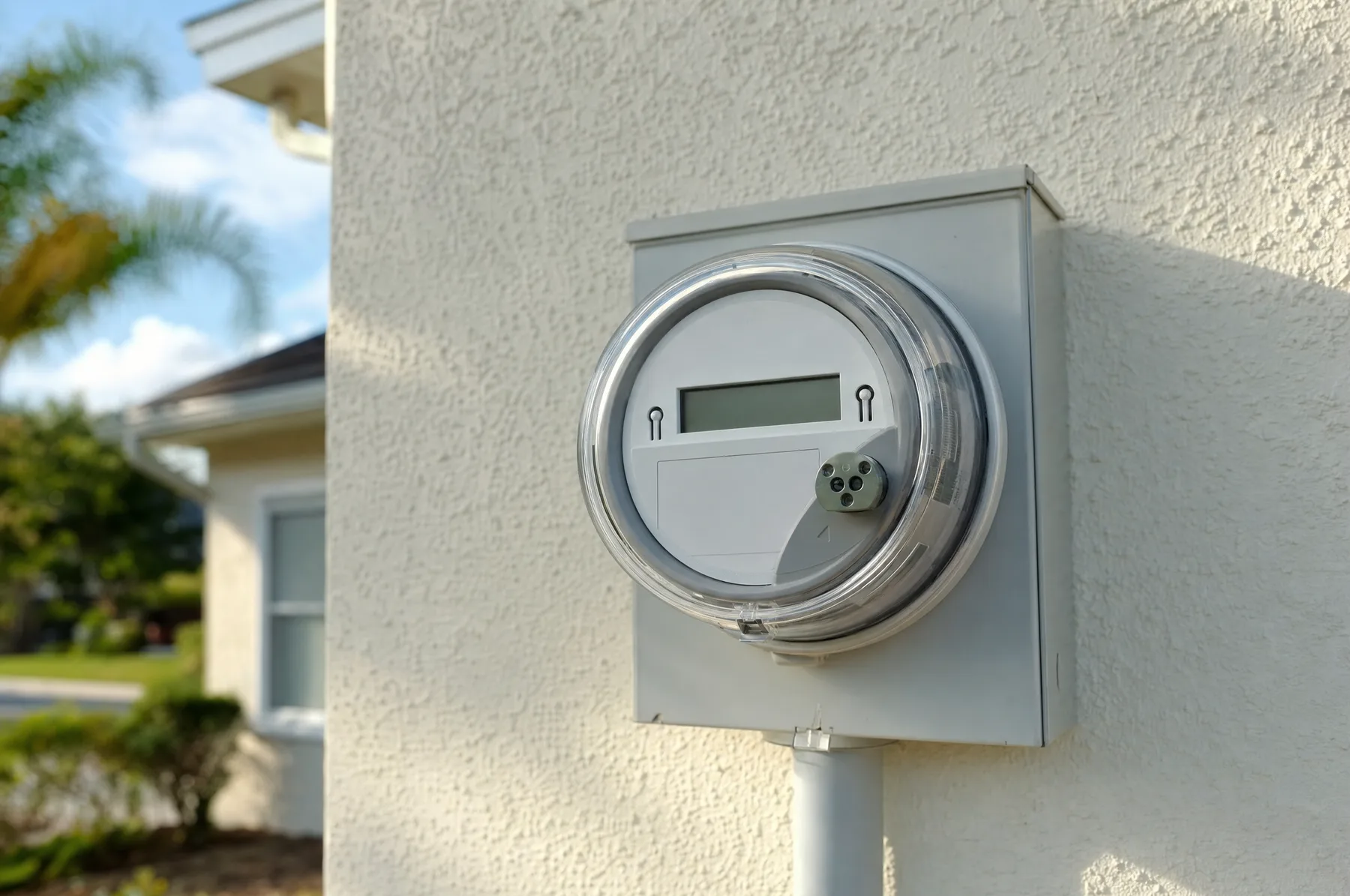
A kWh (kilowatt-hour) is the energy a 1,000-watt appliance uses running for one hour, and it is the unit your utility bills you in. The average Florida home used 1,104 kWh a month in 2024 according to EIA, against 863 nationwide. The gap is almost entirely air conditioning.
What exactly is a kWh?
Two words get mixed up. The watt (W) or kilowatt (kW = 1,000 W) measures power: how hard an appliance “pulls” while it is on. The kilowatt-hour (kWh) measures energy: power multiplied by time. The formula the Department of Energy uses is simple:
(watts × hours used per day) ÷ 1,000 = kWh per day
A 10 W bulb on for 5 hours uses 0.05 kWh. A 2,400 W central AC on for 8 hours uses 19.2 kWh. That second number, times 30 days, is 576 kWh: more than half of Florida’s average bill. Short definition at /en/glossary/kwh; where to find your kWh on the bill, in the guides for Duke Energy, FPL and TECO.
How much does a typical Florida home use?
| Average monthly usage (2024) | Average price | Average bill | |
|---|---|---|---|
| Florida | 1,104 kWh | 14.14 ¢/kWh | $156.09 |
| United States | 863 kWh | 16.48 ¢/kWh | $142.26 |
Source: EIA, Table 5a, 2024 data. Florida pays less per kWh than the national average and still pays more per month, because it uses 28% more. The reason is the climate: in the United States air conditioning is about 19% of residential electricity (EIA, 2020); in a Florida home, the University of Florida (IFAS) estimates HVAC exceeds 40% of usage. An average home at 1,104 kWh may be spending over 440 kWh a month just on cooling.
What does each appliance draw?
The watts below are published ranges; yours depend on model, age and use.
| Appliance | Typical power | Source | What matters |
|---|---|---|---|
| Central AC (3 tons) | ~2,400 W running; 3,000-4,000 W range by system | EnergySage | Compressor hours per day and SEER (the efficiency rating: higher means less energy) |
| Electric water heater | ~18% of a typical home’s energy use | DOE, Energy Saver Guide | Temperature (120 °F is enough) and tank insulation |
| 1.5-hp single-speed pool pump | ~2,000 W at 3,450 rpm | PNNL | Hours per day: running it 6 hours instead of 24 cuts usage 75% (ENERGY STAR) |
| Variable-speed pool pump | Cuts usage 50-90%; ~2,800 kWh and $350 a year less than a conventional pump | PNNL / ENERGY STAR | Halving the speed uses one-eighth of the energy |
| Electric dryer | 1,500-5,000 W | EnergySage | Loads per week and a clean lint filter |
| Refrigerator | 300-800 W nameplate; it cycles, not always at full draw | EnergySage | Age and door seal |
An example with the formula: a 2,000 W pump running 10 hours a day is 20 kWh daily, 600 kWh a month. At Florida’s 14.14 ¢/kWh average, about $85 a month just to move water. Cutting it to 6 hours or switching to variable speed is, in many pool homes, the single best-return measure of all.
Heads up: the industry sells equipment by the wattage label, but the bill is made of hours. An “efficient” AC that runs 14 hours because the ducts leak or the house is uninsulated uses more than an old one that is well installed. That is why the University of Florida hammers on the thermostat: every degree below 78 °F costs up to 8% more in cooling. Before buying, measure.
How do I split my bill among appliances?
Without instruments, split your usage into three pillars: air conditioning, hot water and “everything else”. With the bill in hand:
- Take the lowest month of the year (usually January or February). That is your base usage without AC: water heater, fridge, lights, electronics, pool.
- Subtract that base from the highest month (July or August). The difference is, almost entirely, air conditioning.
- If you have a pool, calculate its kWh with the formula and subtract them from the base.
That tells you where the money is before anyone sells you a solution. Your 12 months of kWh are also the base of any solar math. In the subscription, the savings of at least 30% are calculated on your last 12 months of usage; that is why it requires at least 12 months of history in that home. How that turns into numbers is at how much solar really saves.
When NOT to go into detail
- If your total usage is under 500 kWh a month: you are already far below average and the room for improvement does not justify new equipment.
- If the problem is one isolated month: first check the days in the billing period and whether you had guests or a failing appliance.
- If the lowest and highest months are nearly equal: your problem is not the AC, it is the base (hot water, pool, something on 24 hours).
What to check before deciding
- Your kWh for each month across the last 12 statements, not the dollars.
- The gap between the highest and lowest month: that is your “AC bill”.
- Daily hours of the pool pump and its type (single-speed or variable).
- Water heater temperature (120 °F is the DOE recommendation).
- Your AC’s SEER and age. With those five data points, the home usage estimator gives you a first picture in minutes.
Frequently asked questions
What is the difference between kW and kWh?
Is 1,000 kWh a month a lot?
How do I find out what a specific appliance uses?
Figures vary by home, usage and bill. Incentives vary by county, income and installation type. Confirm any tax matter with your tax preparer.
Sources
- EIA — 2024 Average Monthly Bill, Residential, by State (Table 5a)
- EIA — How much electricity is used for air conditioning in the United States?
- EIA — Use of energy explained: energy use in homes
- UF/IFAS — Energy Efficient Homes: Air Conditioning
- U.S. DOE — Estimating Appliance and Home Electronic Energy Use
- U.S. DOE — Energy Saver Guide (2022): Water Heating
- EnergySage — How many watts does it take to run a house?
- EnergySage — How much energy does an air conditioner use?
- PNNL Building America Solution Center — Variable-Speed Pool Pumps
- ENERGY STAR — Pool Pumps
Keep learning
Your home’s usage
5 things raising your electric bill in Florida (and how to cut them)
Pool pump, old A/C, water heater, leaky ducts and phantom loads: how much each weighs with sources from FPL, DOE and ENERGY STAR, and what to check before deciding anything.
7 min read
Your electric bill
How much electricity costs in Florida in 2026: ¢/kWh and average bill
Florida paid 15.10 ¢/kWh residential in June 2026 versus 18.34 in the U.S., but uses more: the average bill was $156 in 2024. Figures from EIA, EnergySage and the FPL, Duke and TECO tariffs.
7 min read
Your electric bill
How to read your Duke Energy Florida bill in 2026
Customer charge, energy charge, fuel, asset securitization, taxes and the $30 minimum: what each line on your Duke Energy bill means and where to see your usage.
7 min read
2 minutes · No pressure · Spanish or English
Your Central Florida home could start saving this year.
Tell us about your home in 2 minutes. We review your real bill and tell you how much you would save with the subscription. If it doesn’t make sense for you, we say so.